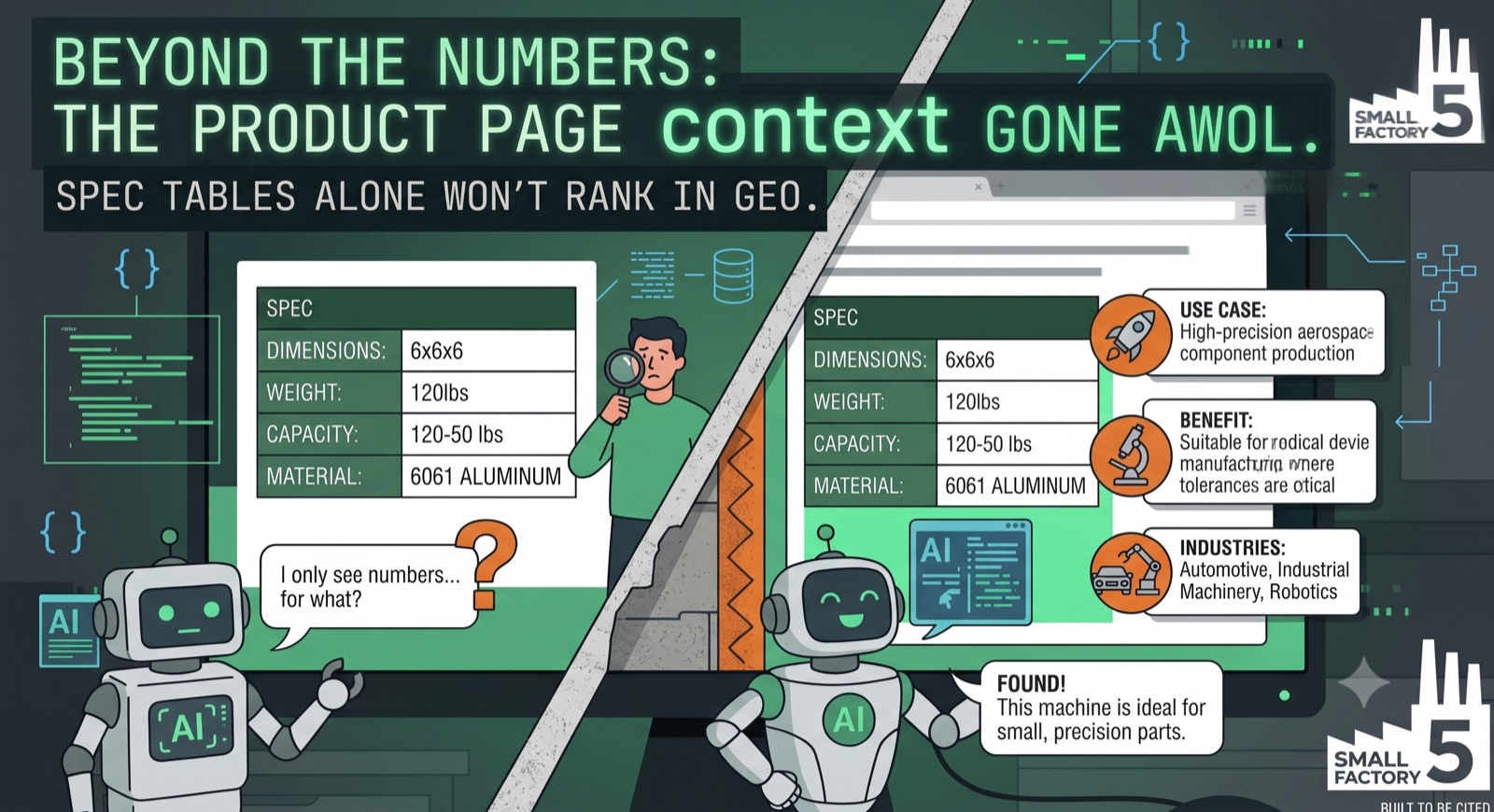
A product page built only from specs won’t rank well and won’t get cited by AI engines, because it never actually answers the buyer’s real question. Specs confirm an answer for someone who already knows what they need. They don’t help someone figure out what they need in the first place, and that second group is now often typing their question into ChatGPT or Google’s AI Overview instead of a search box.
That’s the exact gap I found across hundreds of product pages on a B2B manufacturer/distributor site I’ve worked on. Here’s what was missing, why it matters more than it used to, and what the fix actually looks like.
What’s Missing From a Spec-Only Page?
Each page had the same shape: a product name, a photo, and a spec table. Dimensions, capacities, tolerances. All accurate, all present, all useless on their own.
What wasn’t there: any mention of what the product is actually good at, what gets made or accomplished with it, or which industries rely on it most. A buyer comparing several similar products has to already know the answer before the page is useful to them. So does an AI engine. If someone asks “what’s a good option for X,” a page that’s only a table of numbers gives the model nothing to point to. There’s no context to cite, only data to confirm.
This is the Factual Density lever from the five-lever GEO framework I use, and it’s a common misread of what that lever means. It’s not about cramming in more numbers. It’s about pairing the numbers you already have with enough surrounding context that a reader, human or AI, can connect a spec to a real use case.
Why This Matters More Now That Buyers Ask AI First
A search engine query and an AI prompt aren’t the same request. Someone typing a model number into Google already knows what they want; they’re confirming, not discovering. Someone asking an AI assistant “what’s the best machine for producing small aluminum parts” is doing the opposite: they’re trying to get from a need to a specific answer in one step.
Spec-only pages are built for the first buyer and invisible to the second. And the second type of question is exactly the kind AI engines are answering constantly now, in language that sounds like a real conversation, not a keyword search. A page that only speaks in numbers can’t participate in that conversation. It has nothing to say when the question is framed as a use case instead of a spec lookup.
What Gets Added: Content
Going page by page, three things get layered in alongside the existing spec table:
- What the product actually does well. Not a restatement of the spec table, but plain language about its practical strengths.
- What gets made or accomplished with it. Concrete, specific examples instead of generic capability claims.
- Who it’s actually for. The industries or use cases where this product shows up most often.
As a rough illustration: a page for an industrial machine might go from a table that just lists spindle speed and travel distances, to that same table plus a short paragraph noting it’s well suited to small, high-precision parts in a specific range of tolerances, commonly used in fields like medical device or aerospace component production. The numbers didn’t change. What changed is that the numbers now point somewhere.
None of this replaces the spec table. It sits next to it, so a visitor, or an AI system reading the page, gets both the data and the reason the data matters.
What Gets Added: Internal Linking
Content gaps rarely travel alone. On this same set of pages, internal linking was close to nonexistent. Related products, category pages, and other supporting content existed elsewhere on the site, but the product pages didn’t point to any of it. There wasn’t a system in place at all, just individual pages sitting in isolation from everything around them.
The fix was building that system from the ground up: matching each page against a full crawl of the live site to surface real, relevant connections, rather than relying on someone manually remembering what else on the site was worth linking to. That matters for the same reason the content gap does. A page that’s disconnected from everything else on the site looks, to both a search engine and an AI engine, like an island with no context to draw from.
How to Tell If Your Own Pages Have This Gap
A fast way to check: pull up one of your own product or service pages and ask whether it answers “what’s this for” as clearly as it answers “what does this do.” Most spec-heavy industries default to the second and skip the first entirely, because the first requires someone to actually know the product, not just document it.
If a page only survives being useful to someone who already knows exactly what they’re looking for, it’s not going to hold up in a search landscape where more of the traffic is arriving with a question instead of a model number.
FAQ
Q: What does “factual density” mean in GEO, if it’s not just about having more specs? A: Factual density means concrete, verifiable specifics paired with enough context to be useful. A spec table alone is data. Factual density is data connected to a real use case, so both readers and AI engines can match a product to a need instead of just confirming a number.
Q: Why do AI engines struggle to cite pages that are only spec tables? A: AI engines cite content that directly answers a question. A spec table answers “what are the numbers” but not “is this right for me,” which is the question most buyers, and most AI prompts, are actually asking. Without that connective content, there’s nothing for the engine to lift into an answer.
Q: Does adding this kind of content mean removing or shortening the spec table? A: No. The spec table stays as-is. The added content sits alongside it, giving both a data-first reader and a context-first reader what they need from the same page.
Q: How do you find internal linking opportunities across hundreds of pages without doing it manually? A: By matching each page’s content against a full crawl of the live site, rather than a static list that goes stale as soon as the site changes. That way link suggestions reflect what’s actually live, not what existed the last time someone built a reference list.
Q: Is this kind of content gap unique to industrial or technical products? A: No. Any industry with spec-heavy or data-heavy product pages, software, medical equipment, industrial parts, technical services, tends to fall into the same pattern: specs get documented, context gets skipped. The fix is the same regardless of industry.
Written by David Cox, GEO consultant at Small Factory 5. David has spent over a decade in SEO and paid search, and now focuses on making B2B content clear enough for AI engines to cite, using the same five-lever framework applied in this post.
Ranking isn't the same as getting cited.
If you're not sure whether AI search actually cites this page, that's exactly what a page review checks.
See how it works