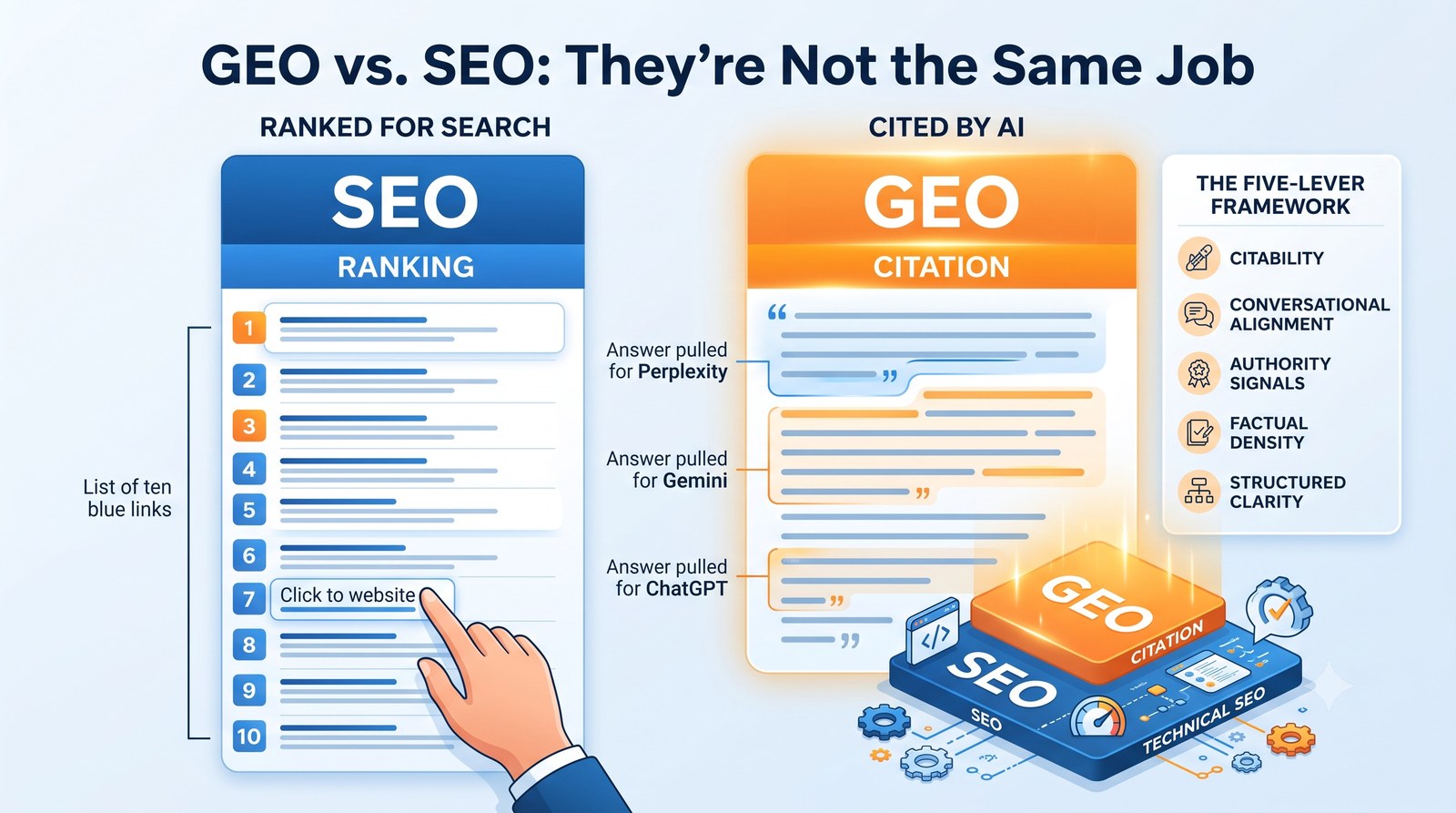
SEO optimizes a page to rank in a list of links. GEO optimizes a page to be pulled into an answer. Those are different targets, and increasingly, different jobs.
The short version
Search engines used to hand you ten blue links and let you do the work. Now AI Overviews, ChatGPT, Perplexity, Gemini, and Copilot read a set of pages, write an answer themselves, and hand the user a paragraph, sometimes with a citation, sometimes without. Ranking #1 doesn’t guarantee you’re the page that answer draws from. Getting cited is a separate outcome, with its own requirements.
GEO isn’t a replacement for SEO. It’s built on top of it. A page still needs to be crawlable, indexed, and reasonably authoritative before an AI system will consider it at all. Technical fundamentals (site speed, clean HTML, working internal links, real backlinks) matter to both. If your SEO is broken, your GEO has nothing to stand on.
Where the two diverge is what they’re optimizing the page for. SEO writes for a ranking algorithm: the win condition is position on a results page, driven by keywords, backlinks, and matching search intent. GEO writes for a different reader: a model deciding, sentence by sentence, whether your page has something worth lifting into its answer. It isn’t ranking your page against nine others; it’s asking whether the page is a clean, quotable, trustworthy source at all.
That difference in reader changes what “good” looks like on the page itself:
- Answer-first structure matters more than keyword density. A model looking to lift a direct answer favors a page that states the answer plainly in the first few sentences over one that builds up to it.
- Factual density beats persuasive copy. Specific numbers, named sources, and verifiable claims are more citable than adjectives.
- Structured clarity (clean headers, FAQ blocks, well-formed schema) makes it easier for a model to parse what your page is actually claiming.
- Conversational alignment means writing toward how people actually phrase questions to an AI assistant, not just the fragment-style queries they type into a search box.
- Authority signals still matter, but the currency shifts toward things a model can verify inline: author credentials, cited sources, consistent facts across your own site, rather than raw backlink count alone.
Those five levers (Citability, Conversational Alignment, Authority Signals, Factual Density, and Structured Clarity) are the framework I run every page review against. It’s the same checklist whether the page is already ranking well or not; ranking and citability are graded separately.
| SEO | GEO | |
|---|---|---|
| Optimizes for | A ranking algorithm | A model deciding what’s worth quoting |
| Win condition | Position on a results page | Getting cited in a generated answer |
| Core signal | Keywords, backlinks, intent match | Citability, factual density, structured clarity |
| Measured by | Rank tracking | Citation / reference rate |
| Fails when | The page doesn’t rank at all | The page ranks fine but has nothing quotable on it |
A concrete example
Picture two pages targeting the same keyword, ranking within a spot of each other in Google. Page A opens with three paragraphs of scene-setting before it gets to the actual answer. Page B states the answer in the first two sentences, then backs it up with specifics.
When someone asks an AI assistant the same question, it’s B that gets pulled into the response. Not because it ranks higher, it doesn’t have to, but because a model skimming for something quotable finds the answer immediately instead of digging for it. Same keyword, same rough ranking, different outcome in the one channel that skips the click entirely.
A note on the hype
Some of the skepticism around GEO is fair. A lot of the stats vendors cite in this space don’t trace back to a verifiable source, and “AI search will replace Google” is an overstatement I won’t make here. One stat that does trace back to something real: the 2023 Princeton/Georgia Tech paper that coined the term GEO tested nine content-optimization methods across roughly 10,000 queries and found that adding real statistics to a page was among the strongest, improving its odds of being cited by up to 41% (Aggarwal et al., 2024). That’s a real study, not a vendor’s slide deck. What I can say without a stat behind it: when an AI assistant answers a question directly, the user often never clicks through to any website at all. In that specific scenario, a page that isn’t structured to be citable simply isn’t part of the outcome, regardless of how well it ranks. That’s not a prediction about the future of search. It’s a description of what already happens today, in a growing slice of queries.
FAQ
Do I need to choose between SEO and GEO? No. GEO assumes a technically sound SEO foundation is already in place. Think of GEO as an additional layer of requirements on top of it, not a replacement.
Is GEO the same as AEO or AIO? They describe overlapping territory. GEO (Generative Engine Optimization) is the term used here because it’s the most common label for optimizing content to be cited by generative AI systems specifically.
Can you guarantee my page will get cited by ChatGPT or an AI Overview? No reputable practitioner can guarantee citation. The models’ selection process isn’t fully transparent or consistent. What’s measurable is whether a page meets the structural and factual conditions that make citation more likely, and whether citation rate improves after changes are made.
How do you measure whether GEO work is actually improving results? Reference rate: how often a page is mentioned or cited across a defined set of AI-generated answers to real buyer queries, tracked before and after changes.
Want to know where your own pages land on this?
That’s exactly what a page review checks: whether a page is built to rank, built to get cited, or neither yet. See how SF5 page reviews work.
Written by David Cox, GEO consultant at Small Factory 5. The five-lever framework above is the same rubric every page review gets graded against, not a simplified version for the blog.
Ranking isn't the same as getting cited.
If you're not sure whether AI search actually cites this page, that's exactly what a page review checks.
See how it works