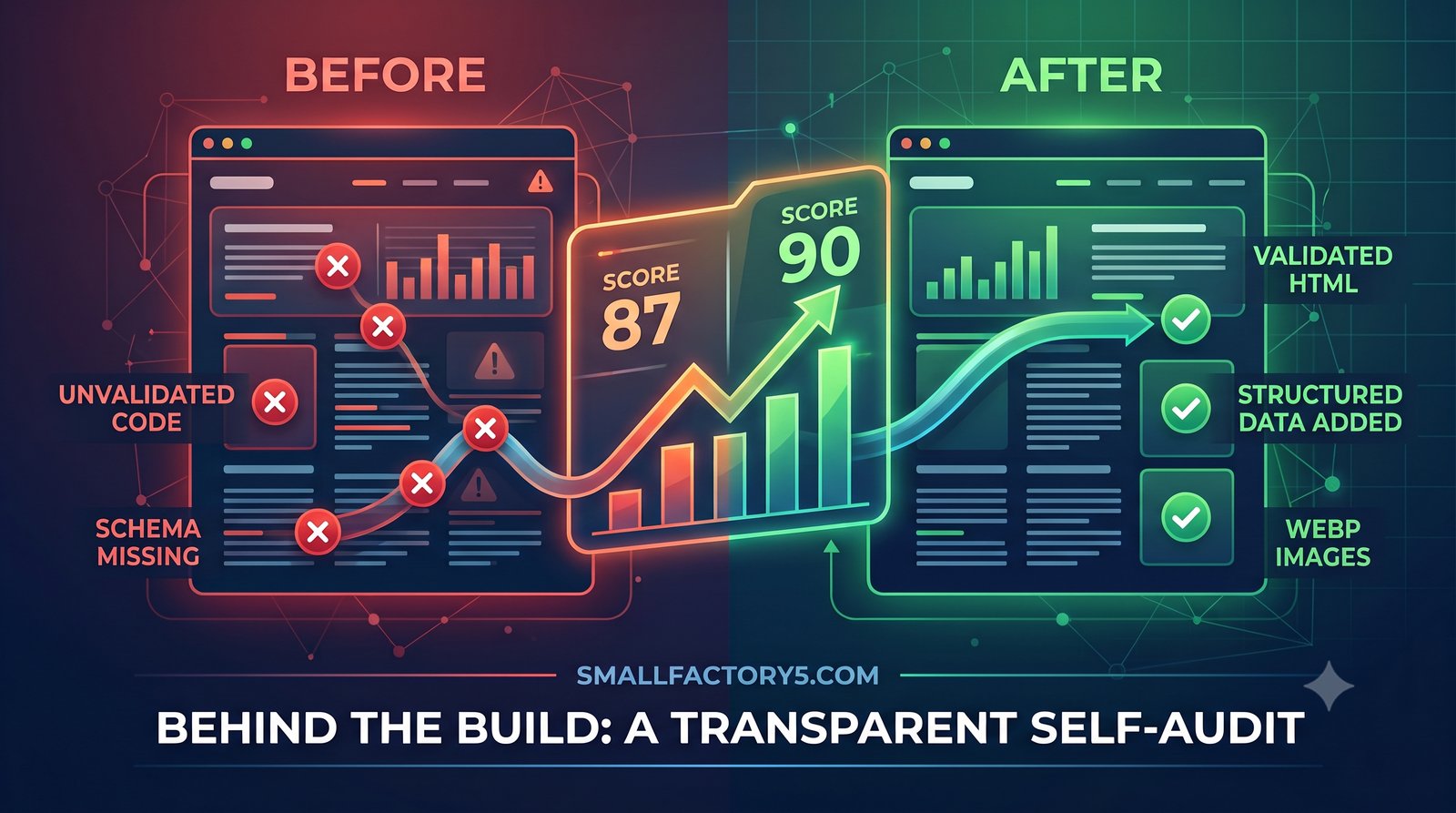
Before I review anyone else’s page, here’s the same audit run on my own: a real, unredacted before-and-after from smallfactory5.com, graded by an independent third-party tool — not something I built or scored myself.
The before/after
| Factor | Before (Jul 16) | After (Jul 19) |
|---|---|---|
| Overall Score | 87/100 | 90/100 |
| Content Structure | 90% | 92% |
| Structured Data | 73% | 77% |
| Technical Health | 89% | 93% |
| Page SEO | 96% | 100% |
What actually changed
Fixed:
- HTML validation — two errors (an invalid
autocompleteattribute on a form field, a skipped heading level) down to zero. Validation status went from “Invalid” to “Valid.” - Heading hierarchy — the H2-to-H4 skip is gone; the outline is clean now.
- Schema completeness — up from 40/100 to 60/100 after adding two more schema types (
Organization,EducationalOccupationalCredential) and filling out the existing JSON-LD more completely. - Image format — both images on the page now serve as WebP directly, not just as a fallback most tooling never noticed. Caught and fixed same day.
Still open:
- Responsive CSS. The grader flags this as missing. It isn’t — the site has extensive
@mediabreakpoints throughout its stylesheet; the tool just doesn’t appear to parse media queries declared inside an inline<style>block. I’m not rearchitecting the site’s CSS delivery to satisfy one grader’s parsing method when every actual visitor on an actual phone already gets the correct, responsive layout. Worth saying plainly instead of hiding it: this line will probably stay “open” indefinitely, and that’s fine.
The five-lever framework isn’t a pass/fail gate, it’s a diagnostic — fixing things in priority order is exactly what a client engagement looks like. I’m not hiding the parts still in progress, including the one that isn’t really a gap at all.
Behind the build: the Citability Index tracker
Part of the five-lever framework is a lever called Citability — whether an AI actually surfaces and cites you when someone asks a real buyer question. That’s a different outcome than ranking, covered in more depth here. I track it for client work as part of the nine-step process’s AI Share-of-Voice step, and the tool I’d used for that is licensed through my day job, not something available for Small Factory 5 client work. So I built the same thing from scratch.
Here’s what it actually does. It asks ChatGPT, Perplexity, and Gemini — the real developer APIs, with web search or grounding turned on, not the consumer chat apps — the kind of question a real buyer would type, then checks two things: does the brand show up anywhere in the answer, and does it show up as an actual cited source URL. Those become a blended 0-100 score, weighted 60/40 toward citation over mention, because being the cited source is the stronger signal — it means the page itself did the work, not just brand-name recognition.
One thing I built in deliberately: a single AI response isn’t a stable measurement. Ask the same platform the same question twice on the same day and you can get a different answer. So every prompt runs three times per platform, and the score is the average across those three calls, not a single pass or fail. Every raw response gets saved to disk before any of it gets scored — the receipts exist if a number ever gets questioned.
On the engineering side: standard library Python only, no third-party dependencies, SQLite for storage, plain HTTP calls to each provider’s API. It defaults to a dry run every time — prints exactly what it would do and roughly what it would cost — and only spends real money with an explicit flag. That’s not a small thing when you’re calling three paid APIs on a schedule.
Where it actually stands right now: the Perplexity integration is verified against a live call. ChatGPT and Gemini are built and structurally ready, but I haven’t tested either against a real key yet, so I’m not calling them finished. I’d rather say that plainly than round up.
I’m not sharing what it’s found on my own site yet — one data point isn’t a trend, and this whole practice is built around not treating a single measurement as fact.
What a page review actually looks like
Same rule as the grader score: real data, my own site, nothing redacted. I ran this homepage through the actual five-lever review — not a summary, the real workflow — and it came back mostly clean, which tracks with the 90/100 above. Four of five levers passed cleanly. The fifth one didn’t, and it’s worth walking through, because it’s a good example of what “Needs Work” actually means in practice — not broken, just not finished.
Conversational Alignment: Needs Work. The FAQ section on this page does this correctly — every header is phrased as the actual question someone asks (“How is GEO different from traditional SEO?”). The services and pricing section didn’t. “Three ways in,” “Page Review,” “Site Audit,” “Monthly” are category labels. The exact price was right there in bold on the page — the section just never phrased the question a buyer is actually holding (“how much does this cost”) anywhere in its own headings. The fix wasn’t a rewrite: one subhead stating the question directly, added above the pricing cards, same day the review flagged it. The cards themselves didn’t need to change at all.
Everything else passed on its own merits: specific numbers instead of adjectives throughout (13+ years, five levers, exact price ranges, exact turnaround windows), a named author with a linked, third-party-verifiable credential, and clean structured data with no heading-hierarchy skips. The report still gets split into self-serve vs. dev-required fixes even when there’s only one item on the list — this one didn’t need a developer at all.
Common questions
Is this a real audit, or a mockup? Real. Both scores come from an independent AI Website Grader, run days apart on smallfactory5.com.
Will you show my results this transparently? No — client audits are private and delivered directly to you. This page exists because it’s my own site, so there’s nothing to redact.
Why didn’t everything get fixed? Priority order, and one honest exception. HTML validation and heading structure were quick, high-impact fixes. Responsive CSS is the one item still flagged — and as covered above, that’s a tool limitation, not a real gap on the live site. I’d rather explain that than quietly make it disappear from the list.
Are you tracking your own AI citation performance too? Yes — more on that above. I’m running the same Citability Index tracker against my own site that I’d run for a client, but I’m not publishing numbers from something this new yet. Track it, don’t guess, applies to my own site the same as anyone else’s.
What happens after the audit? You get a prioritized list split into fixes you can make yourself and fixes that need a developer, plus rewritten on-page copy where needed. See the service tiers for what that looks like at each level.
Numbers above come from Search Influence's free AI Website Grader, an independent tool I don't build or maintain. It's a fast, single-input gut-check I use as a preliminary read before the real five-lever review — not a replacement for one, and not a core part of how an engagement actually runs.
Ranking isn't the same as getting cited.
If you're not sure whether AI search actually cites this page, that's exactly what a page review checks.
See how it works